S&B Engineers & Constructors
Mechanical Engineering Intern · June–August 2026
During my ten-week internship with S&B Engineers & Constructors, I rotated through three areas of mechanical equipment design: pressure vessels, heat-transfer equipment, and rotating equipment. Each rotation combined guided technical training with hands-on engineering exercises, software-based design work, calculation review, and exposure to multidisciplinary EPC project execution.
Confidentiality note: This page intentionally omits client names, project numbers, equipment tags, process conditions, proprietary calculation criteria, and project-specific design values. Billable-work contributions are described only at a general level.
Internship at a Glance
| Rotation | Approximate duration | Primary focus |
|---|---|---|
| Pressure Vessels | 3 weeks | Vessel design, mechanical datasheets, calculations, COMPRESS, and AutoCAD |
| Heat Transfer | 3 weeks | Shell-and-tube and air-cooled heat exchanger thermal design |
| Rotating Equipment | 3 weeks | Pump fundamentals, selection, curves, NPSH, and equipment datasheets |
| Final Presentation | 1 week | Technical communication and internship summary in Houston |
Pressure Vessel Rotation
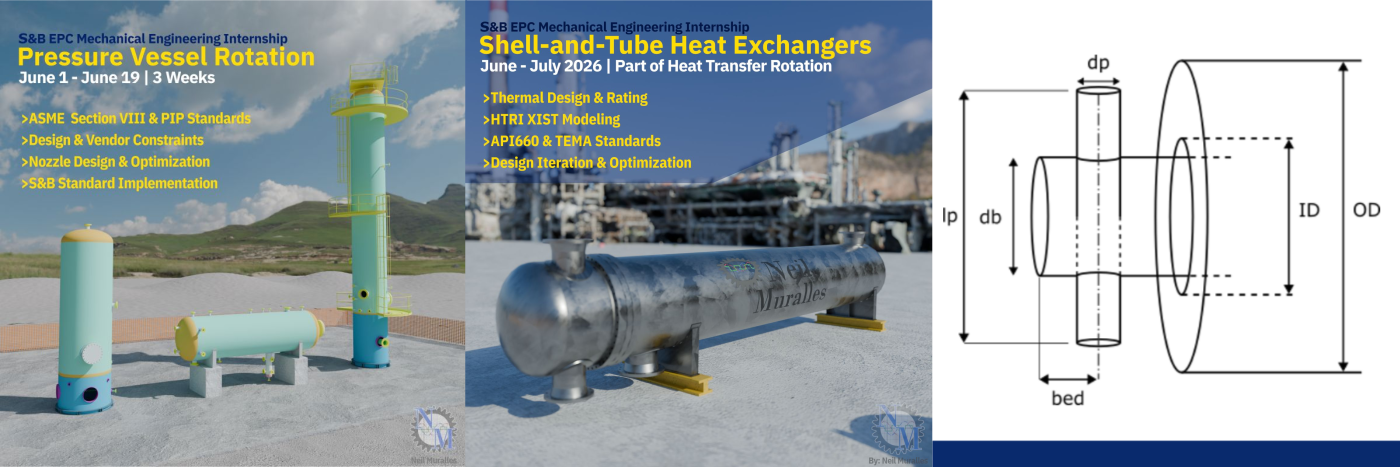
The pressure vessel rotation introduced me to the workflow used to translate process requirements into a mechanical equipment design. I reviewed public industry standards, learned how mechanical datasheets organize design inputs, and built multiple training models of increasing complexity in COMPRESS.
My work included:
- developing pressure-vessel models from completed mechanical datasheets;
- defining shells, heads, nozzles, flanges, gaskets, supports, and external attachments;
- reviewing nozzle reinforcement, external loading, and flange-related considerations;
- producing and revising associated AutoCAD equipment drawings;
- responding to technical feedback and checking that models, drawings, and datasheets remained consistent; and
- learning how ASME Section VIII, PIP practices, and company engineering procedures interact within an EPC workflow.
This rotation strengthened my ability to move between calculations, software models, datasheets, and drawings rather than treating them as separate deliverables.
Heat-Transfer Equipment Rotation
The heat-transfer rotation was the most closely aligned with my interest in thermal systems. I began by completing a published shell-and-tube exchanger example by hand and then recreating the case in HTRI Xist. The close agreement between the hand calculations and software results reinforced the value of first-principles checks before relying on a design program.
I then developed and iterated several training designs involving shell-and-tube and air-cooled heat exchangers. The work included:
- importing and organizing process information for thermal models;
- using HTRI Xist for shell-and-tube exchanger rating and design;
- using HTRI Xace for air-cooled heat exchanger design;
- reviewing public API 660 and TEMA guidance;
- evaluating tube layouts, passes, baffle arrangements, geometry, pressure drop, velocity, vibration, and thermal performance;
- interpreting software warnings and adjusting designs to satisfy competing hydraulic, thermal, and mechanical constraints; and
- using Aspen HYSYS information and Navisworks model context to understand how equipment design fits within the larger process and plant layout.
The strongest lesson from this rotation was that exchanger design is an iterative balance. Improving thermal performance can affect pressure drop, geometry, vibration behavior, cost, and plot-space requirements, so a satisfactory design requires engineering judgment rather than simply maximizing one output.
Rotating Equipment Rotation
The rotating-equipment rotation focused primarily on pumps and the information required to make a technically appropriate selection. I studied centrifugal and positive-displacement pump fundamentals before applying those concepts to curves, datasheets, and vendor information.
Topics and activities included:
- centrifugal-pump components and operating principles;
- pump and system curves;
- net positive suction head available and required;
- affinity laws and the effect of operating-point changes;
- horizontal and vertical centrifugal pumps;
- positive-displacement pump applications;
- public API and PIP pump-selection guidance;
- mechanical datasheet preparation and review; and
- comparing vendor offerings against flow, head, power, solids handling, and operating requirements.
This rotation improved my ability to interpret pump curves and recognize that a valid selection depends on the complete operating envelope—not only the rated flow and head.
Project Contributions
Alongside the structured rotations, I supported active engineering work under the supervision of experienced engineers. These contributions are summarized generically to protect company and client information:
- prepared conservative equipment-weight estimates and compared independent calculation approaches;
- created a reference equipment model to support and cross-check hand calculations;
- reviewed equipment drawings and incorporated approved redline comments;
- compared legacy drawings with current visual documentation to improve drawing clarity;
- checked calculation logic using independent mechanics methods and helped organize the results into a reusable spreadsheet tool; and
- produced clear technical figures to communicate geometry, loading, and calculation assumptions.
These assignments showed me how even a focused calculation or drawing update becomes part of a larger quality-control process involving traceability, peer review, revision control, and clear communication.
EPC and Professional Development
The internship also gave me broader exposure to engineering, procurement, and construction work beyond individual equipment calculations. I participated in multidisciplinary coordination discussions, model reviews, safety meetings, early-career development sessions, technical lunch-and-learns, and a facility visit.
At the end of the internship, I presented a technical summary of my work and lessons learned to engineers and fellow interns in Houston. Building that presentation helped me connect the three rotations and explain how calculations, equipment models, drawings, vendor information, and project coordination support one another throughout an EPC project.
Software and Technical Skills
| Area | Tools and experience |
|---|---|
| Pressure vessels | COMPRESS, mechanical datasheets, AutoCAD, equipment drawings |
| Heat transfer | HTRI Xist, HTRI Xace, Aspen HYSYS information, exchanger design and rating |
| Rotating equipment | Pump curves, NPSH, affinity laws, datasheets, vendor comparison |
| Project coordination | Navisworks, Bluebeam, drawing review, redlines, document checks |
| Analysis and communication | Excel, hand calculations, technical figures, presentations |
Key Takeaways
My internship at S&B gave me practical experience with the full chain of mechanical equipment work: understanding process inputs, performing calculations, building software models, preparing or reviewing drawings and datasheets, incorporating feedback, and communicating the final result.
It also confirmed my strongest interest in thermal systems and instrumentation. At the same time, the pressure-vessel and rotating-equipment rotations gave me a broader equipment foundation and a clearer understanding of how mechanical disciplines work together on large engineering projects.